
Price Impacts on HSFO already well underway; VLSFO & MGO will be next
November 22, 2019
There will be a series of changes in bunker markets as we go through either side of the January 1st IMO 2020 implementation date, and recent price move- ments in HSFO is clear evidence the process is well underway. Read More
There will be a series of changes in bunker markets as we go through either side of the January 1st IMO 2020 implementation date, and recent price move- ments in HSFO is clear evidence the process is well underway.
In mid-September cargo prices for HSFO rose sharply, even to above crude, as bunker demand for the high sulphur product remained ‘as usual’, but availa- bilities were becoming constrained with:
- the initial shift in refining and storage infrastructure from HSFO towards VLSFO and;
- limitations in HSFO trade flows as a result of the steep backwardation in prices because of the impending ‘collapse’ in demand.
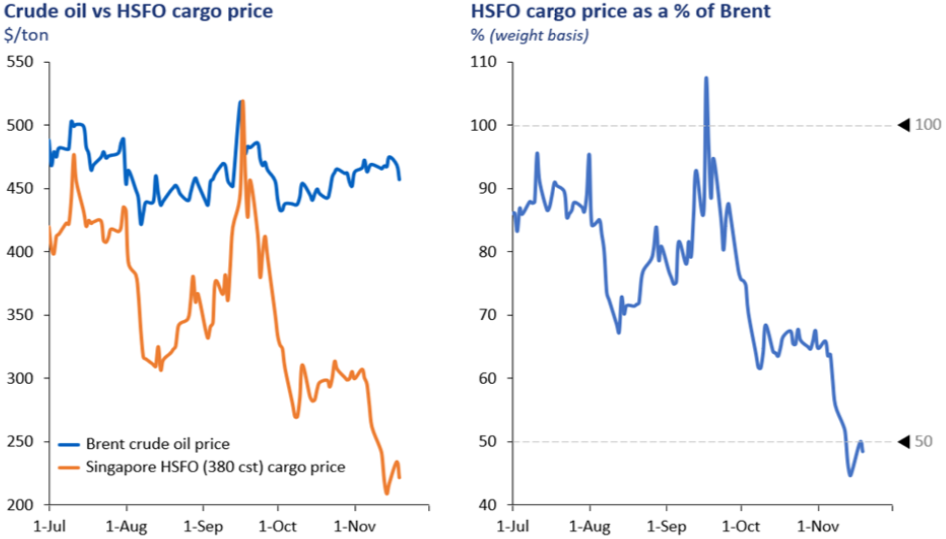
As shipowners move to 0.5% sulphur bunkers, HSFO cargo prices have dropped by half price
However, this mid-September hike in HSFO prices was very short-lived. Since late September demand for HSFO bunkers has fallen away as shipowners re- duce purchases and start to build 0.5% sulphur bunkers onboard ahead of Jan- uary 1st. As a result, cargo prices have been in near free-fall and more than halved over the 2 months to mid-November (from above $500/ton to below $250/ton in Singapore), to a point where HSFO is now only 50% of the price of crude oil, compared with an underlying average of around 80%, and the more recent spike when HSFO went above crude. The initial moves and fall-out of the IMO 2020 change-over are clear to see in the extent of the price drop in HSFO; as it is often said “price tells you every- thing”.
Shifts in HSFO barge and terminal infrastructure can be seen in the premium owners pay for HSFO delivered bunkers over and above the cargo price
This downwards pressure on HSFO prices is likely to continue as more ship- owners switch and build to use 0.5% compliant fuels onboard.
However, there is another nuance to the market change-over, in that buyers of HSFO bunkers haven’t seen the full impact of this drop in cargo prices. This is because owners are switching away from HSFO and towards purchases of VLSFO, so the barge infrastructure is beginning to shift in the same direction. The lower availability of HSFO barges and the growing logistical constraints on the terminal side are clearly represented in the premium owners are paying for HSFO delivered bunkers over and above the cargo price for the product.
In the main bunkering centres, delivered HSFO bunkers were typically around $15-30/ton above published cargo prices. The ongoing transition in the barge markets has meant constrains in this part of the system for HSFO deliveries and these premiums above cargo prices have moved to extreme highs, of above $70/ton in Fujairah, more than $80/ton in Rotterdam and close to $100/ton in Singapore. At this stage, the premiums in Singapore are falling, but in Rotterdam they are rising. We are in the phase where HSFO is still in demand but falling, and the number of barges delivering this product are in decline, with a significant number having to prepare ahead of the large-scale move to VLSFO. Shifting premiums represent the pace at which barges are switching versus the pace of decline in HSFO demand.
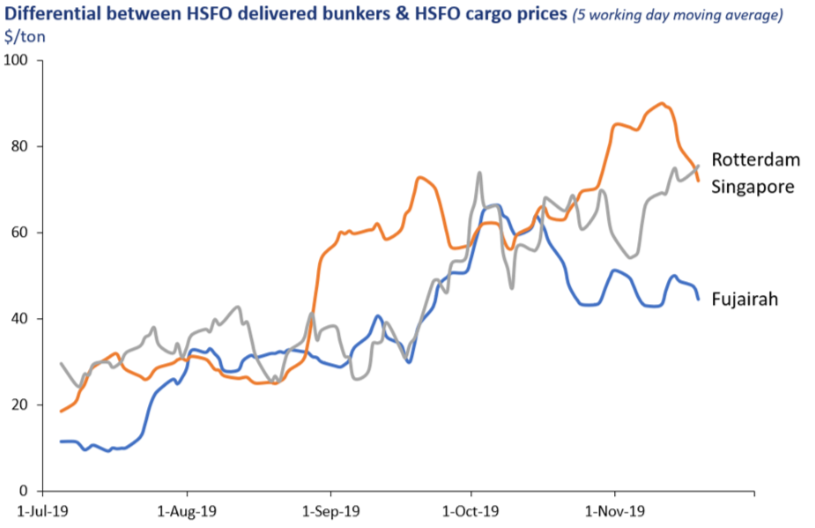
Since late September, the differential between HSFO delivered bunkers and cargo prices has accelerated
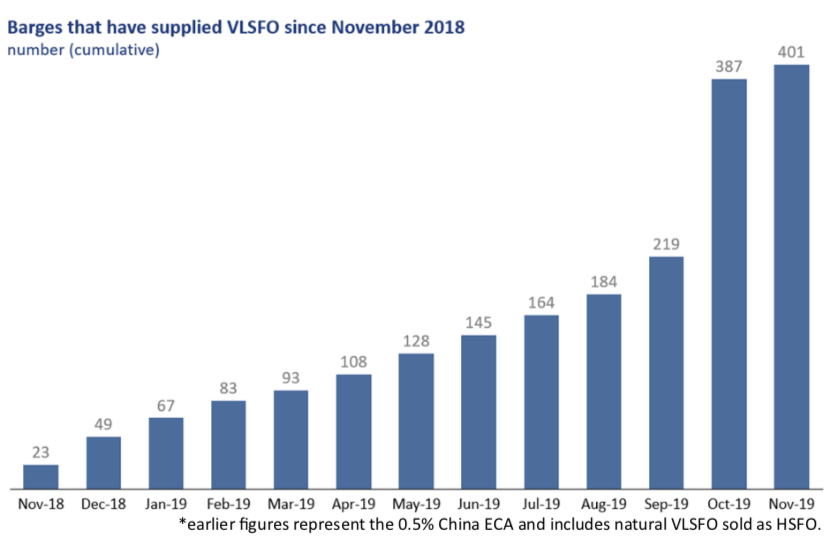
Through to mid-September our analysis indicates around 2-4 barges per week were switching into the VLSFO market. Since late September we can see this number has accelerated to around 40 per week and so clearly taking a toll on the capacity to supply HSFO to vessels.
In Singapore there are more than 300 bunker barges and we have identified 62 of these supplying VLSFO by mid-November (close to 20%). There are around 100 barges in Rotterdam and we have identified a similar 20% proportion that are supplying VLSFO. There is clearly the means to move barges between are- as, but globally we have measured around 12% of the barge market now carry- ing VLSFO and this is one of the factors why the price premium on HSFO bun- ker deliveries has moved to its recent highs.
However, over the same period we have seen virtually no change in the differ- ence between delivered MGO bunker prices and their corresponding cargo price in each region; on this basis it seems the demand and supply in this part of the bunker market has not yet changed significantly; but it will.
Barge premiums for MGO and VLSFO are now expected to rise
In terms of where we go from here, the HSFO premiums above cargo prices should ease as we go through to January, as demand for this product falls to only those owners with operational scrubbers on board. However, as this pre- mium declines, the barge premium for MGO deliveries is expected to rise (potentially to levels we have seen on the HSFO side), as those owners choos- ing MGO as their compliant fuel ramp up purchases. The same could be said for VLSFO as well.
Next year we would expect all premiums over the cargo market prices to be higher than the historical levels of $15-30/ton, given developments in the barge and terminal sectors. However, any ‘excessive’ premiums are likely to be short lived as the flexibility to move barges between markets will cap this, es- pecially in the main bunkering centres.
The number of barges will increase with conversions of small tankers
Given these developments and the added demand in the barge market from having to supply more products/grades than before, we are already seeing conversions of existing small tankers to bunker barges and the ordering of new bunker barges, which will at some stage boost availability at this point of the supply chain.
Overall, there are many moving parts to the bunker supply chain even at this stage. As the industry goes through the end of 2019 and well into 2020, even more changes to storage (land based and floating), barge numbers and opera- tions between HSFO, VLSFO and MGO and various product availabilities will take place. At Integr8 we are monitoring, measuring and closely analysing all these factors in the supply chain to minimise the greater operational and price challenges faced by shipowners and operators because of IMO 2020.
Steve Christy
Strategic Communications Director
P: +2074675860
E: SteveChristy@navig8group.com
Predicting compatibility of VLSFO fuels
November 1, 2019
Overview
Compatibility of residual bunker fuels has always been relevant. Mixing fuels onboard is often considered bad practice, however it is generally unavoidable.
VLSFO’s sensitivity to mixing will likely result in more cases of incompatibility, affecting suppliers and owners alike. Read More
Overview
Compatibility of residual bunker fuels has always been relevant. Mixing fuels onboard is often considered bad practice, however it is generally unavoidable.
VLSFO’s sensitivity to mixing will likely result in more cases of incompatibility, affecting suppliers and owners alike.
Instances of HSFO incompatibility have been relatively rare in the past, given the mostly similar nature of different HSFO streams. This is not going to be the case with VLSFO. With varying nature and quality parameters, these fuels are particularly sensitive to mixing, which will likely result in more instances of incompatibility, affecting fuel suppliers and owners alike.
As part of IMO2020 preparation, Integr8 Fuels conducted a study where VLSFO samples were gathered from various suppliers across the world. Knowing indi- vidual fuel properties, a theoretical methodology was used to assess stability of a blend of two different VLSFOs without testing the actual blend. Such a methodology could prove to be extremely helpful for bunker procurement go- ing into 2020 and beyond.
In order to confirm the accuracy and practical usefulness of this methodology, each case of predicted compatibility was compared with actual physical com- patibility tests, which involved mixing the fuels in question to see how they react with each other. The study concluded that the proposed methodology can be used to predict compatibility with a high level of accuracy and be a very useful tool for buyers of VLSFO.
Why does commingling occur?
To a certain degree, commingling is unavoidable and the risks of commingling occur even if the bunker tanks have been emptied, as sludge and un-pumpable volumes may still be present.
Mixing fuels can happen at different stages in the vessel’s fuel system – in storage, settling or service tanks. While it is often not possible to avoid mixing in service tanks, most owners try to avoid mixing in storage tanks. According to our survey of common practices, some owners allowed up to 20/80 percent HSFO commingling in storage tanks for economic and operational reasons.
The risks of commingling and the varying nature of VLSFO
The main, but not the only risk of commingling, is associated with asphaltene sludge formation. This can happen when two perfectly stable fuels are mixed together creating an unstable blend.
Unlike HSFO, VLSFO’s nature and specs are expected to vary greatly. Different suppliers will offer different fuels with a paraffinic, naphthenic or aromatic predominant base. Mixing such fuels may produce an unstable blend in which asphaltene separation occurs. This can result in clogged filters and separators and in extreme cases lead to engine power loss.
Buying VLSFO of similar nature could help minimise compatibility issues, but our study shows that even fuels of the same nature may pose compatibility challenges if mixed.
How is stability of a blend of fuels ensured today?
There are two main tests that cover stability: the spot test and the Total Sedi- ment Potential (TSP) test. The spot test can be done onboard the vessel, but the more thorough reference test (TSP) is done in the lab normally taking over 24 hours to get the result.
Due to the nature of bunker operations it’s often not possible to pre-test the fuel before taking it onboard, and even less so before fixing the stem — i.e. entering into a contractual obligation to buy it.
Integr8 Fuels compatibility study of VLSFO
This compatibility study is based on using a method to predict the ability of a blend of two VLSFOs to keep asphaltenes in suspension and, therefore, not al- lowing for sludge formation.
Sixteen VLSFO samples of different nature were collected for the study from various suppliers and main locations (Figure 1). These samples resulted in 120 blend combinations (50/50 ratio) to test the method on.

ISO8217 was performed on each sample, together with the following additional tests that are necessary for the compatibility prediction methodology utilised:
- Asphaltene content
- Actual level of aromaticity (ALA) — calculated from viscosity and density
- Minimum required level of aromaticity (MRLA) to keep asphaltenes sus- pended
An individual fuel or a blend is deemed stable provided there is a certain buffer between ALA and MRLA. For individual fuels, the greater the buffer the greater the fuel’s capacity to mix with other fuels keeping asphaltenes in suspension. If asphaltene content, ALA and MRLA are known for the individual fuels to be mixed then, once the proportion of each fuel in the mixture is determined, the expected ALA and MRLA of the blend can be calculated using a formula. In order to confirm the accuracy of the proposed methodology, physical com- patibility tests were performed on the blends, i.e. the spot test and TSP. The predicted results were then compared with these actual physical test results. Preliminary results Theoretical compatibility was run on all 120 blends, with confirmatory physical spot and TSP tests performed on 17 randomly selected blends. Physical tests showed that around 18% of the blends were unstable, meaning the individual fuels used to produce the mixture were incompatible with each other. This re- sult highlights the importance of methodologies that can predict fuel compat- ibility, as the likelihood of two VLSFOs being incompatible is rather high. Table 1 summarises the results of the tests conducted, which show that the level of accuracy reached is high, having obtained only one false incompatible result — i.e. the methodology predicted fuels to be incompatible, when they could be mixed and remain stable — and no false compatible results — i.e. the methodology predicting fuels to be compatible, when they actually turned out to be unstable when mixed.

From a risk management perspective, the robustness of the methodology comes from its ability to highlight instances where supposedly compatible fuels would in reality be incompatible. The methodology used requires further testing and calibration, but these preliminary results are very promising.
Working on the basis of standard ISO8217 testing
The methodology presented appears to have a great ability to predict compati- bility of different fuels, but always provided these three additional properties — asphaltenes, ALA and MRLA — are tested along with ISO8217.
An interesting side result of the study is that some ISO8217 properties can be used as indicators of potential compatibility between different fuels. None of these have the predicting power of the methodology presented above, but they can still be used for compatibility guidance in the absence of extended testing.
It was noted during the study that there is a strong correlation between the asphaltene content and Micro-Carbon Residue (MCR). Figure 2 demonstrates the correlation, which shows that higher MCR was associated with the higher asphaltene content.
Another interesting relationship between variables that arose from the study is that between ALA (Aromaticity Index) and density (Figure 3). Even though ALA is calculated from viscosity and CCAI (which is calculated from density and viscosity), data shows that viscosity plays a minor role and higher density VLSFOs can be associated with higher ALA fuels.


Based on these correlations, the following general guide- lines can be set based on the test results of the standard ISO8217 fuel testing:
- The higher the MCR, the higher the asphaltene level of a fuel and the higher ALA will be required to keep as- phaltenes in suspension.
- Fuels with higher density will likely have higher ALA and, presumably, the higher capacity to hold asphaltenes in suspension.
- In absence of any other information, and only for guidance purposes, it may be concluded that higher densi- ty / lower MCR fuels will tend to be more versatile in terms of mixing, than lower density / higher MCR fuels.
Conclusion
Compatibility is a cause of great concern for owners as VLSFO has proven to be more prone to stability issues when mixed, than its high-sulphur counterpart, which rightfully increases owners’ concerns.
The study shows that it is possible to predict blend stability with high accuracy using additional to ISO8217 testing. In this regard, Integr8 Fuels will continue expanding its sampling program and testing the methodology to help owners navigate the new bunker space.
The proposed methodology is dependant on having additional properties test- ed, even though the study found a correlation between some of the additional properties and the standard ISO8217 set. In this regard, the following sugges- tions can be made to owners who rely on ISO8217 tests only:
- Paraffinic fuels (lower ALA) will encounter trouble mixing with more aro- matic counterparts (higher ALA), as the total aromaticity of the mixture will be reduced. As shown, density can be used as a proxy to ALA, and guide judgment in this regard.
- Fuels with higher asphaltenes may be prone to forming asphaltene sludge once mixed, as the buffer between ALA and MLRA (which is in part a func- tion of asphaltenes level) may be reduced. As shown, MCR can be used as a proxy to asphaltene content, for guidance purposes.
- Fuels with higher aromaticity (likely to present higher density) and lower asphaltene content (likely to present lower MCR), are in principle safer to mix, as there should still remain enough buffer between ALA and MLRA to keep the asphaltenes in suspension.
VLSFOs’ lower tolerance to comingling calls for better bunker planning. Owners should always consider options from different suppliers and, where possible, try to ascertain the nature and quality of the fuel before fixing or delivery. Quality and compatibility have gone from a problem to face once fuels have been delivered onboard, to a problem better dealt with at the point of pur- chasing. Integr8 Fuels have invested heavily in building the largest pool of fuel quality data to help owners in making informed decisions.
Latin America’s transition away from HSFO to VLSFO
September 10, 2019
Recently pricing in the bunker market has been heavily disrupted, particularly in Singapore and Europe, because of logistical issues associated with switching over supply infrastructure to the new low sulphur fuels from HSFO. However, thus far, globally volumes sold and the proportion of volumes sold by fuel type, have remained relatively stable, except for Latin America. Read More
Recently pricing in the bunker market has been heavily disrupted, particularly in Singapore and Europe, because of logistical issues associated with switching over supply infrastructure to the new low sulphur fuels from HSFO. However, thus far, globally volumes sold and the proportion of volumes sold by fuel type, have remained relatively stable, except for Latin America.
However, thus far, globally volumes sold and the proportion of volumes sold by fuel type, have remained relatively stable, except for Latin America.
By monitoring Integr8’s proprietary bunker quality datasets, we are seeing the first real signs of the market adapting for IMO 2020, based on physical sales. This is being observed in Latin America, with an increase in the volumes of VLSFO being sold since the end of August.
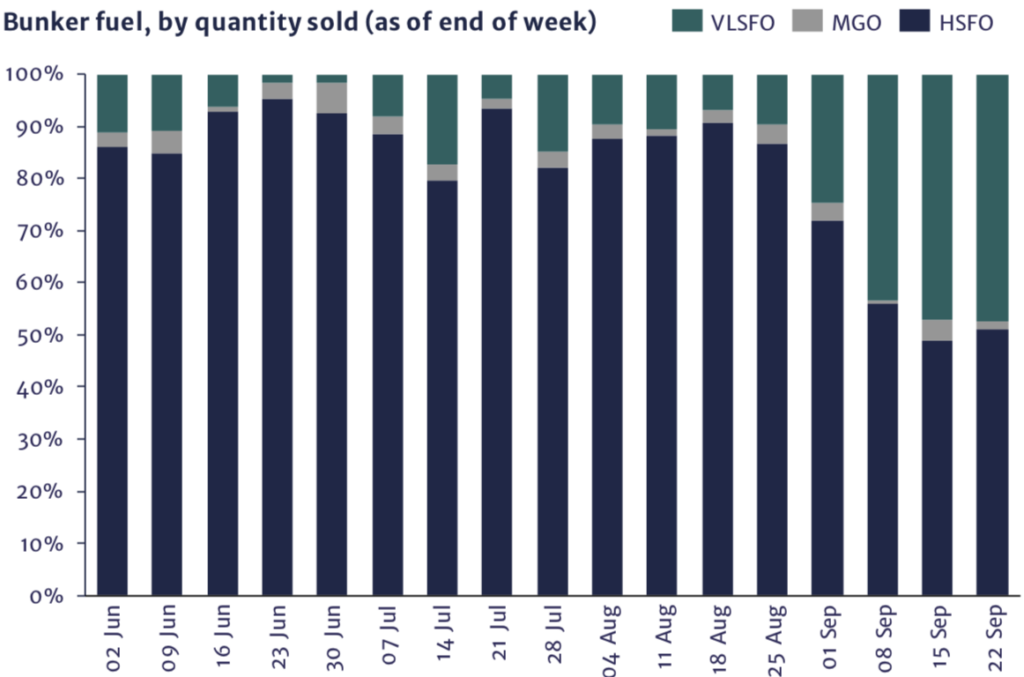
Due to the low sulphur nature of much of Latin America’s crude oil, the supply of fuel oil in the region has often been less than 0.5% sulphur, even when a premium for low sulphur fuel oil bunkers was not available.
However, we are now witnessing suppliers in Latin America doing a very good job of separating low sulphur streams from high sulphur streams to produce greater volumes of VLSFO. The ability to separate streams (in the refinery and further down the supply chain) has been discussed at length by oil market ex- perts, but this is the first real market evidence that suppliers are successfully doing this.
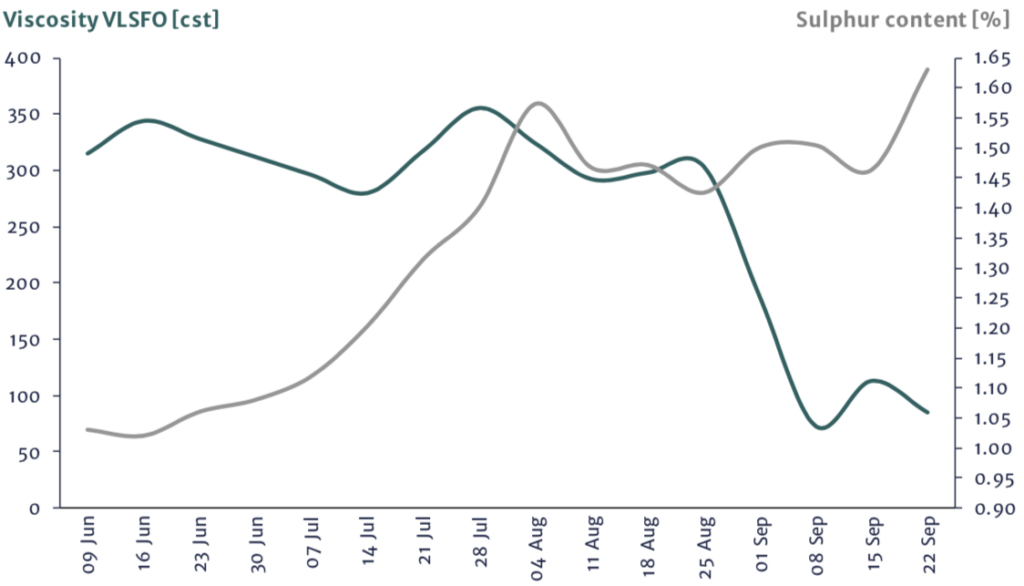
Indeed, a rise in the average sulphur levels of HSFO being sold is an indicator of streams being segregated in a way they were not previously. The average sulphur level of HSFO bunkers in Latin America was 1.0% in June 2019, but in the first few weeks of September 2019 the average sulphur level had risen to 1.5%. Indeed, a rise in the average sulphur levels of HSFO being sold is an indicator
Meanwhile, analysis of the viscosity, pour point and Aluminium + Silicon of VLSFO type fuel being sold in June and September 2019 in Latin America sug- gests that VGO (rather than distillate) is also being blended with straight run low sulphur fuel oil to meet the growing demand for VLSFO.
What we are seeing is in keeping with what we are hearing about suppliers’ plans. The key regional supplier Petrobras will reportedly stop selling HSFO from 1st October, to shift to VLSFO.
Integr8’s proprietary datasets allow us to monitor in a timely manner changes occurring in the bunker market. This has never been more important than at the current moment in time. The change occurring in Latin America is the most dramatic IMO 2020 effect we have seen so far. However, the rest of the global market will now begin to move as well.