
News October 29, 2026
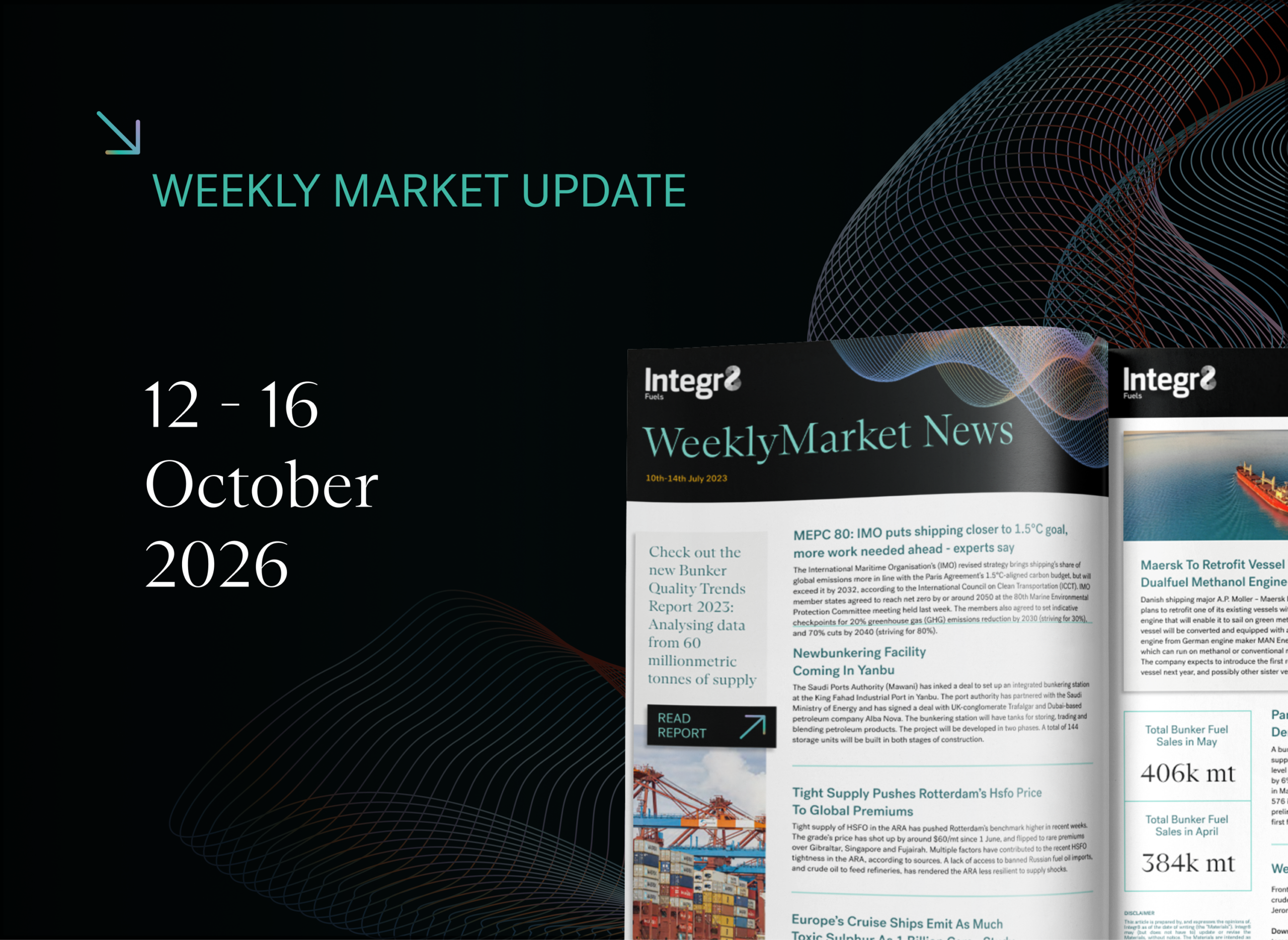
Weekly Market Update 26 October – 30 October 2026
What moved the bunker market this week?
Every Friday, our research team breaks down the key developments shaping bunker prices, fuel availability and global shipping. Explore the week’s essential stories, understand the forces driving the market, and see what bunker buyers should be watching next.
Download this week’s market update (PDF, recommended for mobile) »
JERA lines up Indian green ammonia for bunkering in Japan
Japanese power generation company JERA has agreed to buy around 70,000 mt/year of green ammonia from India’s AM Green over five years. The ammonia will come from AM Green’s Kakinada plant, which is under construction with a production capacity of 1 million mt/year and due to be commissioned by 2028-29.
JERA is one of seven Japanese companies that have agreed to develop an ammonia bunker supply chain in Japan’s Chubu region. Most of the ammonia will go to a joint venture of shipping lines Kawasaki Kisen Kaisha (K Line) and Nippon Yusen Kabushiki Kaisha (NYK). The supply agreement could be extended to cover additional volumes. The venture will use a new bunker vessel to supply four ammonia-capable car carriers, mainly at the ports of Nagoya and Mikawa. The bunker vessel and car carriers are due for completion in 2030.
Riga port eyes green methanol production and bunker hub
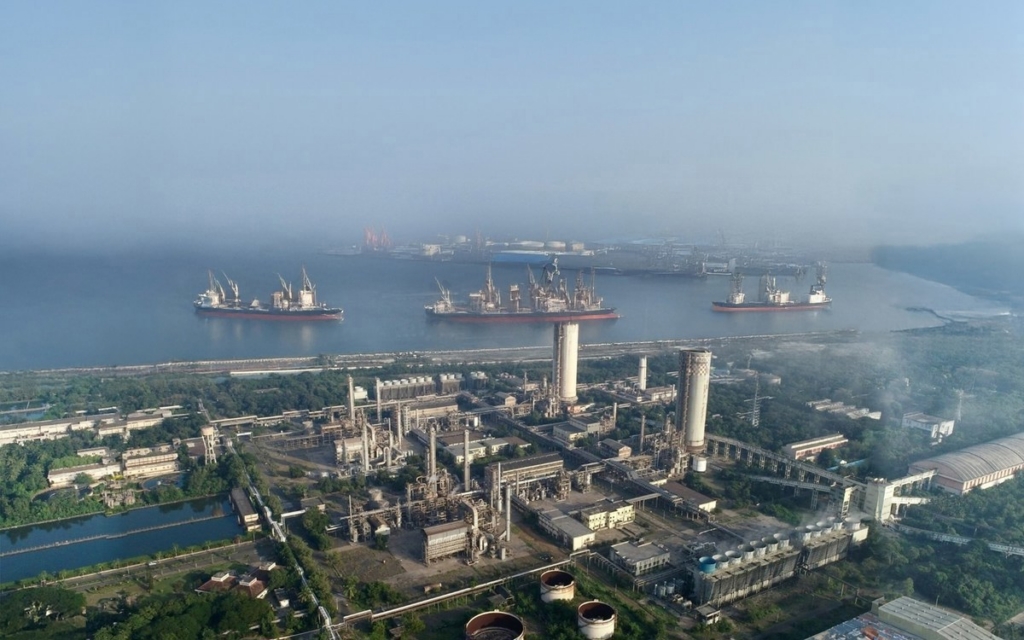
The Freeport of Riga Authority, South Korean green methanol producer Ecomethanol and Latvian consultancy AE Risinājumi have agreed to develop a green methanol production facility at the Port of Riga, producing the fuel for export and for use as marine fuel. The partners will also explore establishing a green fuel supply and bunker hub at the port.
The project could open up opportunities to supply vessels sailing between Europe and Asia via the Northern Sea Route, the port authority said. The companies have yet to disclose the plant’s planned capacity or timeline.
FEATURED MARKET ANALYSIS
Diesel Tightness Puts Oil and Bunker Prices Under Pressure
Supply is recovering and demand is down, yet bunker prices are up +40%. Expert contributor Steve Christy explains why, and what could turn the market.
Read the analysis →Port of Santos moves to regular ethanol bunker supply
Brazil’s Port of Santos has moved from trial to regular ethanol bunkering, the Santos Port Authority said. The 13,000 TEU containership CMA CGM Iron received ethanol on 19 October, following a pilot operation in July. The vessel’s tri-fuel engine is the world’s first certified to run on ethanol, the companies involved said.
Copersucar supplies the ethanol, AGEO Terminais stores it and Bunker One delivers it at the Santos Brasil terminal under a protocol built around the fuel’s low flash point.
“Following the first operation carried out in July, we are now moving into a new phase, demonstrating that ethanol can be incorporated into maritime operations safely, reliably and on a commercial scale,” said Giovani Grassi, chief executive of CMA CGM Brazil.
Nuclear’s case for containerships hinges on IMO’s NZF
A nuclear-powered containership cannot compete on cost with a conventional vessel without the IMO’s Net-Zero Framework (NZF) in force, a UCL Energy Institute study has found. Researchers compared a 14,500-19,999 TEU ship powered by a small modular reactor with conventional fuel oil and ammonia-capable vessels out to 2050. Under the NZF, nuclear ships could earn revenue by selling surplus compliance units, as their zero funnel emissions would put them well below greenhouse gas intensity limits.
However, reactor cost is the biggest factor in the model, with estimates varying nearly five-fold. At the low end, which assumes reactors built in series at lower cost, a nuclear ship sailing at 14.85 knots could become the cheapest option from 2040 if the NZF is in force. At the high end, it would never be the cheapest. Revenue from surplus units also falls as the rules tighten towards 2050, so the study argues nuclear’s best opportunity lies in entering the market early.
MOL takes delivery of LNG-capable coal carrier
Japanese shipping firm Mitsui O.S.K. Lines (MOL) has taken delivery of the 95,000-dwt LNG-capable coal carrier Maizuru Kazenomai from Oshima Shipbuilding. The vessel will carry coal for Japanese utility Kansai Electric Power to its Maizuru Power Plant, and has a hard-sail wind assisted propulsion system that MOL developed with Oshima. MOL plans to have 25 vessels fitted with the sail by 2030 and 80 by 2035.
Safe Bulkers takes delivery of first methanol-capable bulk carrier
Dry bulk operator Safe Bulkers has taken delivery of its first methanol-capable bulk carrier, the 81,200-dwt Kypros Island, from Japanese shipbuilder Tsuneishi Shipbuilding. The vessel was delivered at Tsuneishi’s yard in
Zhoushan, China.
A sister ship is due in January 2027. There are currently 169 methanol-capable vessels in operation globally, with another 295 on order, according to DNV data.
Antwerp-Bruges bio-bunker sales halved on the quarter
Biofuel bunker sales in the Port of Antwerp-Bruges fell 50% to 13,000 mt in the third quarter, from 27,000 mt in the second quarter, according to port authority data. That was the port’s lowest quarterly biofuel volume since the fourth quarter of last year.
Antwerp-Bruges’ biofuel sales were down 76% from 56,000 mt in the same quarter last year. Biofuels accounted for less than 1% of the port’s total bunker sales in the third quarter. Overall bunker sales rose 5% quarter on quarter to 2.16 million mt.
The port sold 61,000 mt of biofuel in the first nine months of this year, down 56% from 140,000 mt in the same period last year.
Rotterdam’s bio-bunker sales also fell in the third quarter, dropping 38% on the quarter to 154,000 mt. Unlike Antwerp-Bruges, Rotterdam has sold more biofuel in 2026 than in the same period last year.
| Antwerp-Bruges bio-bunker sales in Q3 | 13,000 mt |
| Antwerp-Bruges bio-bunker sales in Q2 | 27,000 mt |
Market Snapshot
Weekly Brent developments
Front-month ICE Brent is heading for a 3% fall on the week as renewed US efforts to restart talks with Iran outweigh fresh Houthi attacks on Saudi energy sites.
Downward pressure
US Vice President JD Vance sent a letter to Iran’s Security Council chief Mohsen Rezaei in a bid to revive peace talks, the Wall Street Journal reported. Qatari mediators have also presented Iran with a new draft deal to end the Middle East war, and Iranian Foreign Minister Abbas Araghchi said on Wednesday that Tehran continues to give diplomacy a chance, Reuters reported.
Upward pressure
Yemen’s Houthis claimed recent attacks on pumping stations along Saudi Arabia’s East-West pipeline and the 550,000 b/d Ras Tanura refinery. Saudi authorities have not confirmed either strike.
Meanwhile, the US has warned Gulf countries to prepare for a short but intense campaign against Iran, the Wall Street Journal reported. US commercial crude stocks fell by 1.9 million bbls to 410.6 million bbls in the week to 23 October, US Energy Information Administration data showed.
Read the weekly bunker market news from last week here.
We have traders covering every region in the world – let us guide your bunker buying strategy. Contact us.
Disclaimer
This article is prepared by, and expresses the opinions of, Integr8 as of the date of writing (the “Materials”). Integr8 may (but does not have to) update or revise the Materials, without notice. The Materials are intended as general information, not to be relied upon or read as business, investment, legal, tax or other advice. The Materials are not addressed to, and do not contemplate, the individual circumstances of any person. Integr8 makes no representation as to the Materials’ accuracy, completeness, authenticity or source. Each person must independently evaluate the Materials. Save for this disclaimer, the Materials are not intended to create legal relations, and are not an offer or invitation from Integr8, its affiliate or any other person. In preparing the Materials, Integr8 has acted on its own behalf and not as an agent or representative. To the fullest extent permitted by applicable law, Integr8 shall have no liability in contract, tort (including negligence) or otherwise for any loss or cost whatsoever, whether direct, indirect, incidental, special, punitive or consequential, in any way connected to the Materials. The Materials may not be used, copied, reproduced, disseminated, quoted or referred to in any publication or other document (with or without attribution) without the prior written consent of Integr8.

Posted by
Research Team
Latest articles

Contact our Experts
With 65+ traders in 13 offices around the world, our team is available 24/7 to support you in your energy procurement needs.