
News November 25, 2026
Falling Prices Mask a Tighter Bunker Market
Prices are much lower than a month ago
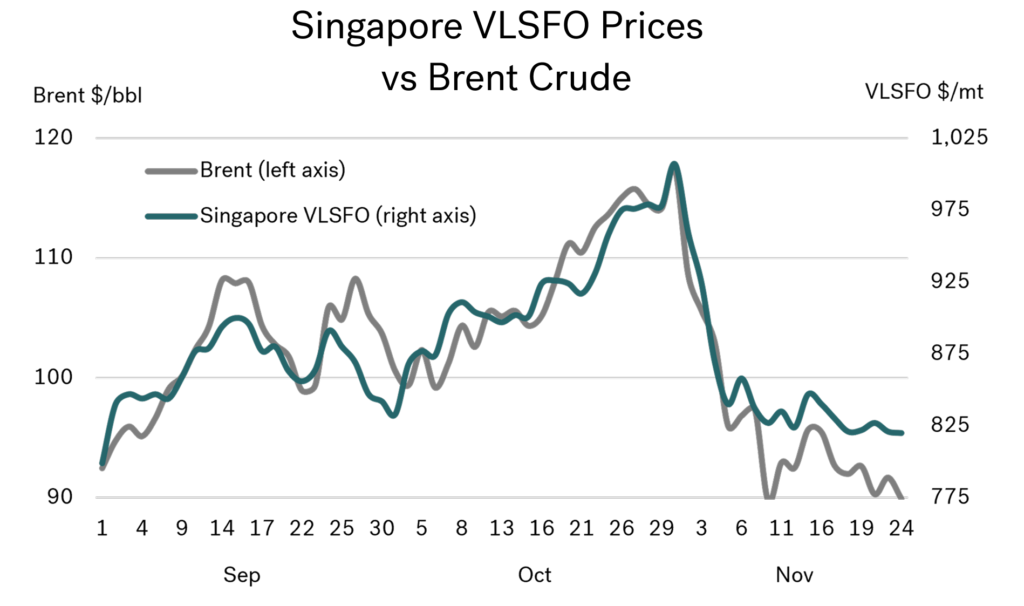
Oil prices fell sharply at the start of November, as optimism grew around peace talks in the US-Iran war and more crude exports began flowing out of the Middle East. Brent crude futures fell from $117/bbl to around $90/bbl, a decline of more than 20%. VLSFO prices followed suit, with Singapore prices falling by almost $200/mt over the past four weeks to around $820/mt.
At first glance, the recent price movements suggest a much-improved position for bunker buyers.
Source: Integr8 Fuels
However, the wider market context tells a different story
Market developments can look quite different depending on the timeframe being considered. Over the past three months, the most notable development has been the near 20% drop in prices at the start of November. In the short term, this represents a significant improvement for bunker buyers compared with a month ago.
However, the market needs to be viewed in the context of the wider conflict, which has now been ongoing for nine months and has had a substantial impact on global oil markets. Comparing current prices with those prevailing before the war gives a very different picture.
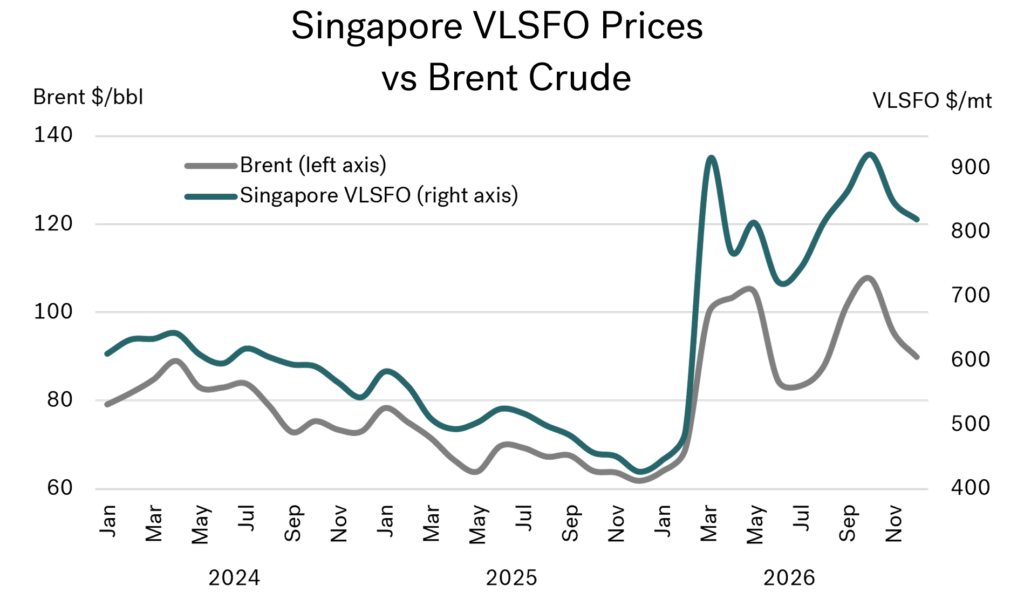
While Singapore bunker prices have recently fallen by almost 20% to around $820/mt, this remains significantly higher than the levels seen in the two years before the conflict, when prices were on a sustained downward trend and Singapore VLSFO had fallen to close to $400/mt.
Source: Integr8 Fuels
Looking at the market over a two-year period, the picture is less positive. Once the war is over, this period is likely to be remembered as one of high oil prices, whether Singapore VLSFO is trading close to $800/mt or $1,000/mt.
Crude prices and refinery margins remain key factors
Looking at the graph above, two key factors have driven bunker prices higher during this period. Firstly, the much higher absolute level of crude oil prices, which sets the baseline for all oil products across the barrel. Secondly, the substantial increase in refinery margins to record highs. These higher margins reflect the impact of the war on refinery operations, including lower throughput, reduced product availability and declining oil product stock levels.
The graph illustrates both the rise in crude prices and the additional impact of higher refinery margins on the bunker market, shown by the widening gap between Singapore VLSFO and Brent. For bunker prices to fall further, we need to see refinery margins ease and/or crude oil prices decline.
Global refinery throughput has fallen sharply
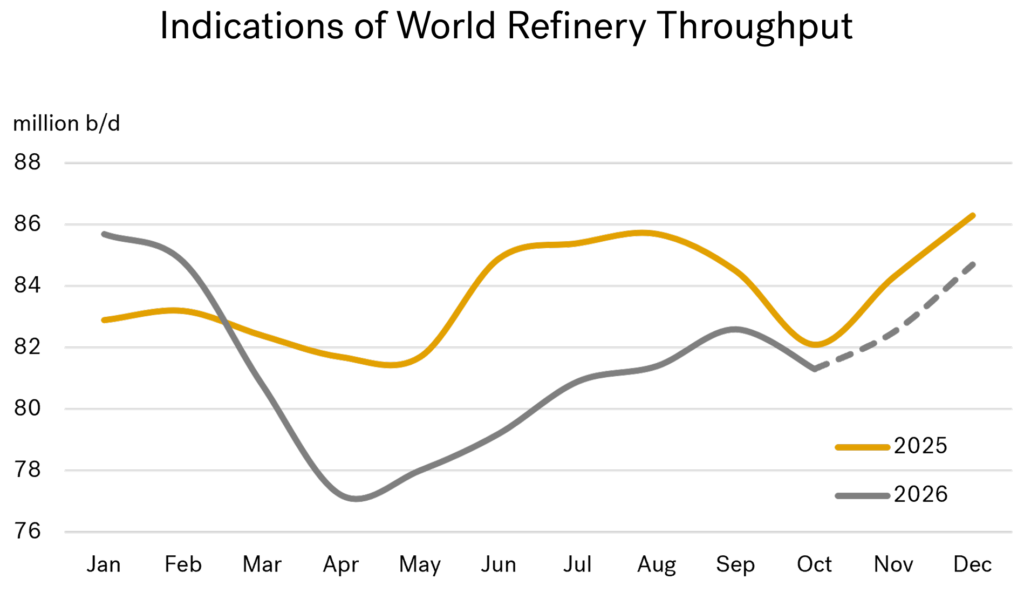
On a global scale, the US-Iran war has led to a significant reduction in refinery throughput. Between April and August this year, global crude processing volumes were down by around 4-6 million b/d compared with 2025 levels.
Source: Integr8 Fuels
On a more positive note, refinery throughput has generally increased since mid-year, and this trend is expected to continue through to the end of the year. However, despite this recovery and a decline in global oil demand, the overall market has continued to tighten. This is reflected in significantly lower oil stocks and much higher
refinery margins.
The key question is whether higher refinery runs will be sufficient to rebuild depleted oil stocks, ease refinery margins and take some of the pressure off bunker prices?
In the short term, the answer is probably no, particularly for Singapore VLSFO prices
Globally, refinery runs remain below last year’s levels. This is compounded by the substantial draw on product stocks resulting from the squeeze in supply. It will take time for markets to rebalance, even as refinery output increases. Furthermore, conditions vary between regions, meaning prices are likely to ease more in some markets than others. Extremely high shipping costs and logistical re-routing are also continuing to constrain the trade flows needed to improve regional supply.
Regional differences in refinery throughput
Refinery throughput in the Middle East was among the first to be affected by the onset of the war, with crude processing running at around 2 million b/d below 2025 levels. There are some signs of recovery, but expectations are that throughput will remain more than 1 million b/d below last year’s level through to the end of the year and
into 2027.
European refinery runs have been largely unaffected and have remained relatively close to 2025 levels throughout 2026. Instead, it has been the loss of product imports into Europe that has tightened the market. Direct supply losses from the Middle East, indirect losses from India and ongoing sanctions on Russian oil imports have all contributed to much higher refinery margins. The European market needs a significant increase in product import volumes before margins can fall substantially.
In the US, refinery runs have actually been slightly higher than last year. The country also benefits from relatively high domestic crude production, alongside near-dedicated supply flows from Canada. As a result, the US has probably been the least affected by the war in terms of refinery operations. However, no region can fully isolate itself from the global effects of the conflict, and prices have also risen in the US, particularly in the increasingly tight middle distillate markets.
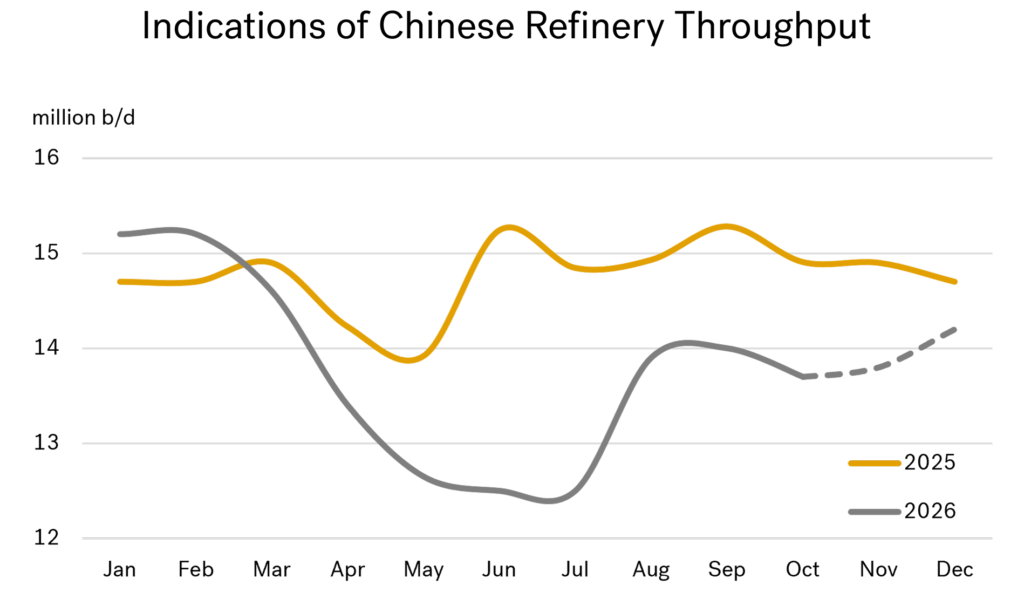
Outside the Middle East conflict zone, the biggest impact on refinery operations has been in Asia, particularly China. Chinese refinery runs would typically be expected to increase year on year. In 2025, throughput was around 0.3 million b/d higher than in 2024. However, the net impact of the US-Iran war has been a substantial reduction in Chinese refinery operations this year. Runs were down by around 2.5 million b/d at mid-year and remain approximately 1.2 million b/d below 2025 levels.
Projections indicate that Chinese refinery runs will increase, but are still unlikely to return to 2025 levels, let alone record year-on-year growth.
Source: Integr8 Fuels
All bunker buyers have been affected, but Asian buyers have faced greater pressure
The Asian region has been hit by a combination of reduced crude imports from the Middle East, lower oil product imports from the region on which it is heavily reliant, and constraints on local product supplies from Asian refiners, particularly reduced exports from China.
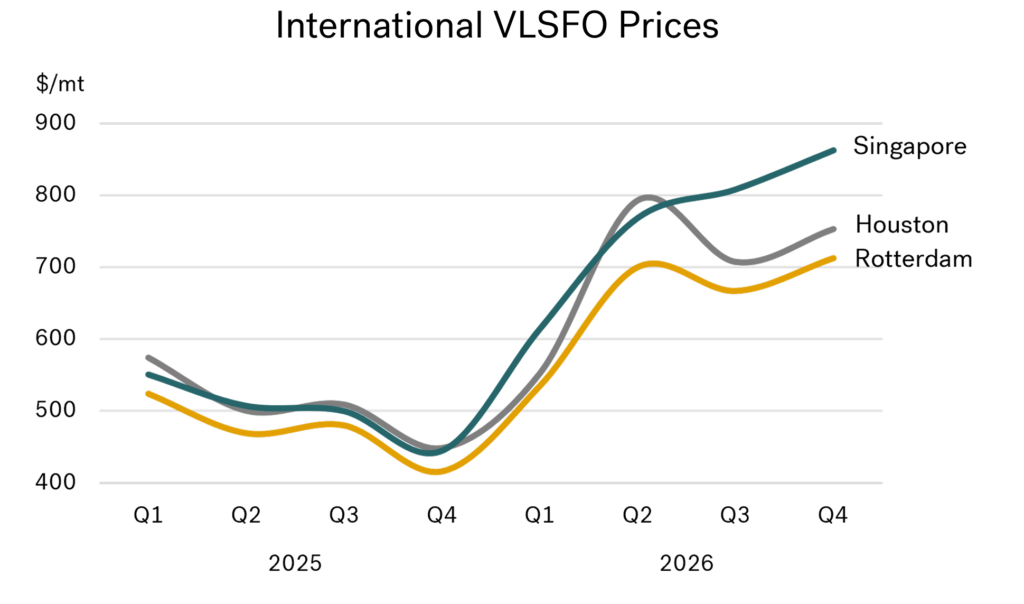
The price relationship between the key bunker markets tells much of the story. Before the war, Singapore VLSFO prices were broadly in line with Houston, and around $30/mt higher than Rotterdam. Today, prices in both Rotterdam and Houston are significantly higher than before the war, but the relationship between these two markets has remained largely unchanged, with Houston trading at a slight premium.
Source: Integr8 Fuels
The biggest difference is now between prices in the East and West. Before the war, Singapore VLSFO prices were broadly in line with Houston and around $30/mt above Rotterdam. They are now trading at a substantial premium of around $110/mt to Houston and $150/mt to Rotterdam. This suggests that the impact of the war is adding around $110-120/mt to costs for Singapore VLSFO buyers compared with buyers in Europe and the US.
Can lower refinery margins provide some relief to bunker buyers?
Refinery margins may ease from their recent record highs, helping to reduce bunker prices slightly. However, they are unlikely to return quickly to 2025 levels. This pricing pressure is expected to remain a key feature of the bunker market through the rest of this year and into 2027. We can also expect Asian markets to remain under greater pressure than those in Europe and the US, keeping Singapore prices well above Western levels. So, while some easing in refinery margins may take a little off VLSFO prices, the scope for relief is likely to be limited.
The most likely trigger for a sharp fall in bunker prices remains an end to the war and a substantial decline in crude oil prices. Even then, refinery margins may remain relatively high, as extremely low oil product stocks will take time to rebuild. Singapore VLSFO would therefore still trade at a premium to Brent crude, but against a much lower crude price baseline.
Want to talk through what this means for your procurement strategy? Get in touch with our trading desk today.
By Steve Christy, Expert Contributor

Posted by
Research Team
Latest articles





Contact our Experts
With 65+ traders in 13 offices around the world, our team is available 24/7 to support you in your fuel procurement needs.