
News August 26, 2026
The Crude Disruption Is Changing More Than Prices
We have to look beyond bunker prices; availabilities and quality are also issues
We have rightly focused on price in these monthly reports since the start of the US-Iran war, with the implications for us in bunkers being huge.
Our recent reports have highlighted the extreme price volatility and the false dawns around an ‘imminent’ peace.
We now shift our emphasis to the consequences of the war. Here, we focus on the changes taking place in the quality of global oil supply, particularly the massive loss of medium and heavier grades from the Middle East.
In the first instance, this has created huge challenges for the refining industry. However, any disruption to refining can have a major impact on bunker availabilities and potentially on bunker quality. It is worth understanding what is happening in refining to get a steer on the implications for the bunker market. This is important not only now, with the loss of these Middle East supplies, but also for the changes that are likely to take place once peace is achieved and the Strait of Hormuz is fully reopened.
Price is still part of the story
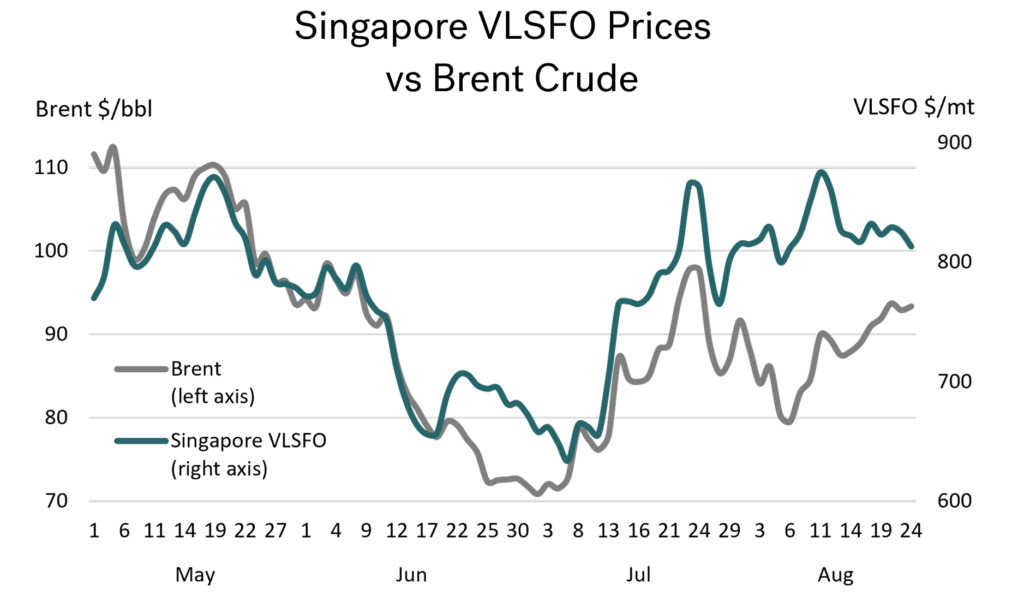
Having said all this, we cannot totally ignore price, so here is a brief update. Over the past month, Brent futures first eased to $80/bbl, but have since rebounded to above $90/bbl. Crude futures continue to move in direct response to sentiment surrounding the US-Iran war.
The key point for us in bunkers is that Singapore VLSFO prices never fell in line with crude and have generally continued to trade in the $800-850/mt range. This means Singapore VLSFO prices are again trading at a major premium to crude, and at higher levels than at any time since mid-March, following the initial two-week period after the war started.
Whilst the Strait is closed, we will continue to be exposed to the underlying price movements in crude and the developments in the refining sector that have pushed bunker prices to such extreme premiums to crude.
 Source: Integr8 Fuels
It’s no surprise that many refiners are running a different blend
of crudes
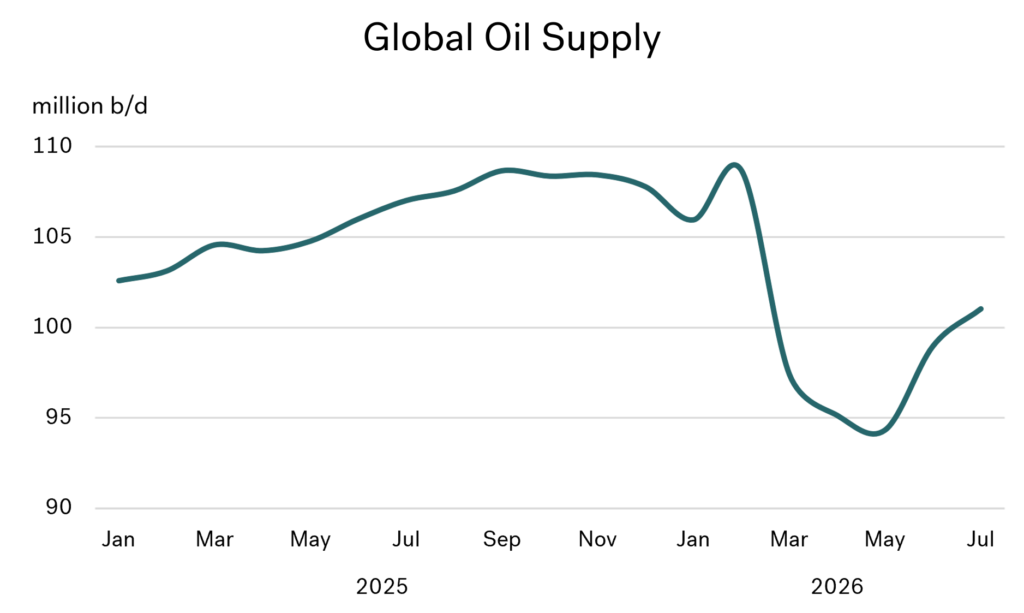
At its peak, there was a loss of more than 15 million b/d in Middle East production between February and May. In addition, there was a further temporary loss of 0.5 million b/d in North Sea output due to seasonal maintenance. Although we saw increases in production in Brazil, the US, Kazakhstan, Nigeria and Venezuela during this period, there was no way the industry could make up for such a massive and sudden loss of Middle East supply.
The net result was that total world oil supply dropped by more than 14 million b/d in just three months.
Source: US EIA
Middle East production and exports were boosted in June and July by the shuttling of crude to locations outside the Arabian Gulf, together with a temporary easing of restrictions via the Strait of Hormuz as ‘promising’ peace negotiations took place. However, peace was short-lived, the Strait closed again, and shuttling operations and volumes remain highly variable and unpredictable.
In addition, the Houthi threat in the Bab el-Mandeb region is forcing Red Sea exports to move north towards the Mediterranean via the Sumed crude pipeline or the Suez Canal.
Given the difficulty in moving oil volumes out of the Arabian Gulf and the Red Sea, global oil supply could fall again in August. The blockades and uncertainty are obvious reasons why crude oil prices remain at such high levels.
The primary loss of oil supplies is all focused on medium and heavy grades
The challenges for the refining industry are clearly enormous under these conditions, even with the use of oil stocks. Asia-Pacific has been the hardest-hit region, with a greater proportion of Middle East crude and products traditionally heading in this direction. Refinery runs in Asia have fallen sharply, but high refinery margins still provide an incentive to secure the most suitable crudes from wherever they are physically and economically available.
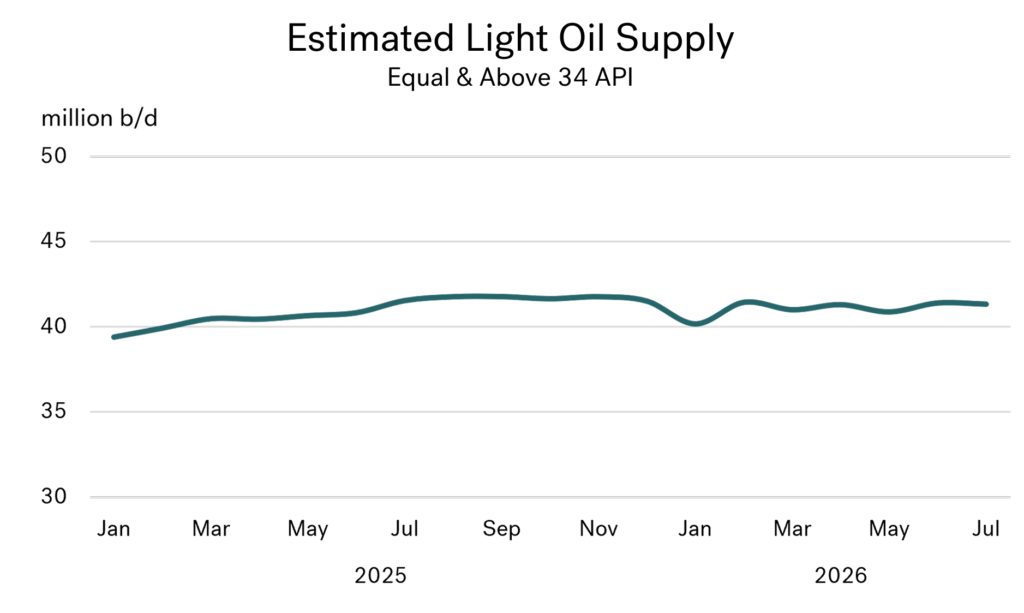
The problem is that refiners are facing diminishing supplies, and all of these losses are in medium and heavier crudes, generally below 34 API. The following graph illustrates this, using broad proxies for crude qualities by main country and region.
 Source: Integr8 Fuels
This is not a definitive breakdown, but it gets us close to the situation faced by refiners. If you were running these Middle East medium and heavy crudes, you would have to be aggressive in looking for alternatives, while also ensuring you can process a new crude diet to balance product outputs, maximise margins and still make on-spec supplies. This brings the added potential complications of sulphur, acid and metals in the alternative crudes
being processed.
For us in bunkers, there is yet another layer of complexity to contend with, taking into account blending operations under these rapidly changing refining conditions. It has been far from ‘business as usual’.
 Source: Integr8 Fuels
It’s not easy for refiners of lighter crudes
On the face of it, refiners taking lighter crude streams may appear to have had an easier time, as crude supplies in this category have remained relatively stable throughout the war. However, ‘traditional’ buyers of these grades will have faced far more intensive competition from refiners looking to ‘fill the gap’ created by the loss of Middle East exports. No one is immune to what is happening.
A challenging job made even more challenging
The challenges for bunker buyers are always there, but under these war conditions they take on added extremes of price volatility, even greater premiums to crude and the difficulty of securing physical availabilities. With the shift in the types of crude being processed, it is also worth keeping a closer watch on any changes in bunker quality. Information on price, availability and bunker quality becomes an even more valuable commodity under
these conditions.
Want to talk through what this means for your procurement strategy? Get in touch with our trading desk today.
By Steve Christy, Expert Contributor

Posted by
Research Team
Latest articles


Contact our Experts
With 65+ traders in 13 offices around the world, our team is available 24/7 to support you in your energy procurement needs.